Preparing for the CSW Exam: What it’s like and tips for study!
Gain insights from a Certified Specialist of Wine’s journey, offering practical study tips, exam strategies, and personal experiences to guide your certification path.
Make 2026 THE year.
Take 10% OFF your first 12 months of Tasting Group!
Code:
Before we get into it, a few quick definitions so we’re working from the same starting point.
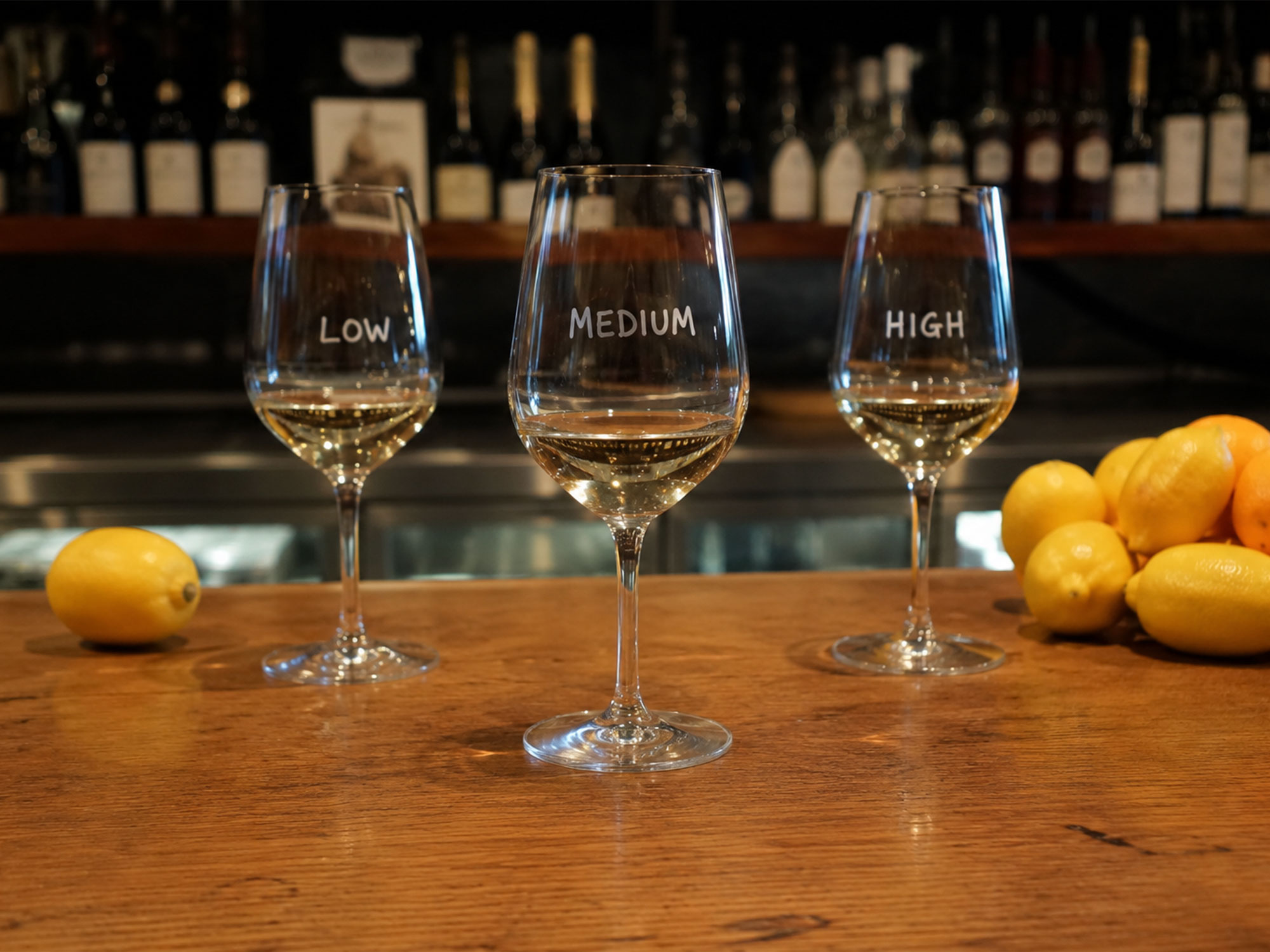
Structure calls are how we describe a wine’s physical components in blind tasting. Acid, tannin, body, alcohol. Each one gets assessed on a scale. Low, medium, and high are the three positions on that scale, sometimes broken into medium minus and medium plus once you get more comfortable. Calibration is the process of training your palate to recognize where something actually falls on that scale, not just where it feels safe to put it. A benchmark wine is a reference point, a wine you return to repeatedly because it reliably represents a particular level of a particular structure. And side-by-side tasting is exactly what it sounds like: tasting two wines at the same time specifically to feel the contrast between them.
The medium trap is what happens when “medium” stops functioning as a precise assessment and instead becomes a safe default.
Here is something I remember clearly from right before my WSET Level 3 practical exam. We were doing a run-through. The instructor asked me about body on a specific wine. I knew it. I had tasted it. My palate said medium plus. And then I opened my mouth and said “medium.”
Not because I thought it was medium. Because medium felt safer to say out loud in front of a bunch of other people.
This the medium trap! Medium sits in the middle of the scale, which means it is never catastrophically wrong. If the answer turns out to be medium plus or medium minus, you are still close. If it turns out to be high, you are at least in the neighborhood. The fear of being far off is what pulls people toward the center, even when their palate is telling them different.
Other students say “medium” not because they’ve calibrated it, but because they haven’t calibrated enough yet, and it feels like the safest answer.
Without enough experience tasting benchmarks or comparing wines side by side, “low” and “high” feel unclear, so “medium” becomes a default.
Some wines genuinely live in the middle. Merlot is often medium across the board. Warm-climate Pinot Noir can sit in a medium range for body and tannin. Tempranillo often falls there too. Neutral, unoaked whites like Pinot Grigio and Pinot Gris frequently land in that medium zone. Even a Chablis-style Chardonnay tends to be medium in most categories except acid.
Medium is a meaningful structural call for a lot of varieties. In fact, when everything is coming up medium, that pattern itself can be a useful clue pointing you toward certain grapes.
So medium is not wrong. Medium can be correct. The issue is whether you arrived there through calibrated comparison or through avoidance.
If you are calling medium because you genuinely perceive the wine sitting in the middle of your scale, that is calibration. If you are calling medium because you are not sure and medium feels like the safest place to land, that is hesitation dressed up as a call.
Medium only exists in relation to the extremes. Without a clear sense of high acid, medium acid doesn’t really have a place.
Start with the edges. Find a wine that clearly represents low acid and a wine that clearly represents high acid. Taste them and feel the difference. Let your palate register what those extremes actually feel like in your mouth. Once you have that, the middle becomes more clear because you now have two reference points to triangulate from.
Once low, medium, and high are starting to feel reliable, then it makes sense to introduce sub-levels. Medium minus means leaning toward the low end without crossing into low. Medium plus means leaning toward the high end without quite arriving there.
But trying to work with medium minus and medium plus before low and high are solid is like trying to learn fractions before you understand whole numbers. Best to learn the extremes first!
For acid, the contrast you want is something clearly low versus something clearly high. A Gewruztraminer can serve as a lower-acid white reference. A dry Riesling is almost always going to give you high acid. Taste these two side by side! That contrast is your calibration anchor for acid.
For tannin, you want the same kind of clear contrast. A California Merlot tends toward softer, lower tannin. A Nebbiolo from the Langhe, if Barolo feels like too much of an investment, will give you the other end of the spectrum. Grippy, drying, unmistakably tannic. Tasting those side by side will give your palate a clear sense of what low tannin and high tannin actually feel like as physical sensations.
For white body, a Veneto Pinot Grigio is a solid light-body reference. An oaked Napa Valley Chardonnay sits at the fuller end. For reds, a lighter-bodied Beaujolais or similar style on one end, and an Australian Shiraz on the other. Notice the weight of the wine in your mouth.
| Structure | Low Reference | Medium Reference | High Reference |
|---|---|---|---|
| Acid | Gewruztraminer (Alsace) | Pinot Grigio (Veneto) | Dry Riesling (Germany) |
| Tannin | Grenache (Australia) | Merlot (California) | Nebbiolo (Langhe, Barolo) |
| Body (white) | Pinot Grigio (Veneto) | Chardonnay (Chablis) | Chardonnay (California – oaked) |
| Body (red) | Gamay (Beaujolais Villages) | Merlot (Bordeaux) | Shiraz (Australia) |
| Alcohol | Gamay (Beaujolais Villages | Sangiovese (Chianti Classico) | Zinfandel (California) |
Tasting a wine in isolation is enjoyable when you are relaxing or socializing! But for studying, tasting two wines next to eachother is more helpful! When you taste a wine in isolation, you naturally locate a sensation on an absolute scale with no reference points nearby. That is hard, even for experienced tasters.
When you put two wines next to each other, something different happens. Your palate starts comparing them. The higher-acid wine tastes more alive next to the lower-acid one. The tannic wine feels drier and grippier when there is a softer wine right beside it.
Comparison reduces guesswork! It is not just about having two wines. It is about training your palate to feel differences rather than recall them from memory. Repeated side-by-side exposure to the same benchmark wines is what builds a sensory library over time.
In our monthly tasting group, we do something simple but surprisingly powerful to help calibrate structure: during blind flights, everyone submits their calls anonymously on a poll before anyone speaks, low to high.
Then we reveal the group results.
Everyone can immediately see where their palate landed compared to everyone else (but without being exposed). Maybe you called a wine medium acid, and most of the group sat at medium-plus or high. It’s not about being right or wrong, it’s useful calibration data. It gives you a reference point outside your own head and highlights where your internal scale might be sitting, almost like checking your compass against someone else’s map.
Group tasting adds something you simply don’t get when tasting alone. Solo tasting builds skill, but it can also reinforce your own assumptions without you realizing it. You end up calibrating against yourself. A tasting group breaks that loop. It exposes you to other calibrated palates, other baselines, and other ways of experiencing the same wine.
The next time you feel yourself reaching for medium, ask yourself one question: if I had to lean lower or higher, which direction would I go?
Most of the time, you have a lean. You are not actually sitting perfectly in the middle. You just are not sure enough to commit to the direction. Trust it enough to at least acknowledge it, even if you end up landing on medium minus or medium plus rather than going all the way to low or high.
Write your call down before you hear what anyone else thinks.
| Question | What to listen for | What to do next |
|---|---|---|
| Would I lean lower or higher? | A pull in one direction, even a small one | Call medium minus or medium plus rather than straight medium if a lean is present |
| What benchmark does this resemble? | A wine from your anchor list that feels similar | Locate the wine on your scale relative to that benchmark |
| Have I tasted this side by side before? | Whether your call is based on comparison or isolation | If isolation only, note the uncertainty and revisit with a comparison wine |
For certification-minded wine students [LINK] working within exam-based study, structure calls are a core part of what gets assessed. The ability to make consistent, calibrated calls under time pressure is a real skill, and it is one that is built through practice, not theory.
The medium trap tends to show up most clearly under pressure. When the clock is running and confidence is low, the middle feels like the safest place to be.
Students preparing within the WSET system, or working toward CMS or CSW-style tasting expectations, will find that consistency in blind tasting [LINK] matters more than occasional accuracy. A palate that reliably lands close to the right call is more useful than one that occasionally nails it and frequently drifts.
The Grape Grind is not affiliated with, endorsed by, or an official preparation provider for WSET, CMS, or CSW.
If you want a more structured place to start building these habits, our free Intro to Blind Tasting course walks through the foundational framework for making structure calls with more consistency and less guesswork. It is a good starting point if you are ready to move from passive tasting to deliberate practice.
Gain insights from a Certified Specialist of Wine’s journey, offering practical study tips, exam strategies, and personal experiences to guide your certification path.
Discover Bordeaux’s diverse terroirs, from the Cabernet Sauvignon-dominant Left Bank to the Merlot-rich Right Bank, and explore its renowned sweet wines and classifications.
Uncover the truth behind sulfites in wine—why they’re added, how much is typical, and why “sulfite-free” wines still contain them naturally.
(Learn to Taste or Refresh Foundations)
(Ask, Discuss, & Connect)
(Gain Tasting Confidence)
Join our totally free community, which includes:
Just submit your info to receive your invite!
By submitting, you are consenting to receive marketing emails from The Grape Grind, including much of the core educational content you’re specifically signing up for now. You can unsubscribe at any time.
Joining the free Grape Grind community means your wine tasting journey begins NOW!
STEP 1 of 2 – Fill this out:
After you click the button above, you’ll be asked to enter your email again to set up your free account. Please use this same email address to create your account.
By submitting, you are consenting to receive marketing emails from The Grape Grind, including much of the core educational content you’re specifically signing up for now. You can unsubscribe at any time.
Learn & improve your wine tasting skills for free!