All You Need to Know about Oregon Wine Country
Explore Oregon’s 23 AVAs, from the renowned Willamette Valley to emerging regions like Rogue and Applegate, where cool-climate wines thrive.
Make 2026 THE year.
Take 10% OFF your first 12 months of Tasting Group!
Code:
Here’s a question you can ask with every wine you taste: does it finish on fruit, or on something else?
You’ve probably heard wines described as “fruity”, pretty much everyone has. It’s a decent descriptor. Most wines have some fruit character. The big question is whether fruit is still leading when you reach the end of your sip, or whether something else has quietly taken over by then. Earth, maybe. Something mineral or stony. A savory note you can’t quite place?
This is a helpful tasting observation. One that, once you start making it consistently, starts to do real work in blind tasting.
A fruit-driven wine is one where ripe, expressive fruit dominates the nose and palate, and the finish returns to that fruit character rather than moving toward earth or mineral.
Ripe fruit tends to feel louder and more immediate. Tart or neutral fruit, like a crisp green apple or a restrained lemon note, does not carry the same weight or expressiveness. A wine built around those quieter fruit characters may not read as fruit-driven at all, even though fruit is technically present.
Important Nore: fruit-driven does not mean sweet. A dry wine can be intensely fruit-forward. The fruit flavor and the sugar level are separate things. Conflating them is one of the more common misassociations in tasting.
In white wines, fruit-driven character tends to show up as tropical fruit, stone fruit, or riper citrus like grapefruit. These are flavors with some weight and exoticism to them. They feel expressive rather than restrained.
Some examples:
The variety matters, but it is not the whole story. A Chardonnay from Burgundy and a Chardonnay from a warm part of Australia are not the same tasting experience, even though they share a grape. Climate and winemaking shape what you actually taste.
In red wines, fruit-driven character tends to show up as juicy, ripe cherry, dark berry, or jammy fruit. The fruit feels plump and immediate rather than restrained or secondary.
Some examples:
Again, these are tendencies, not rules. The same variety in a cooler climate or in a different winemaking style can read very differently.
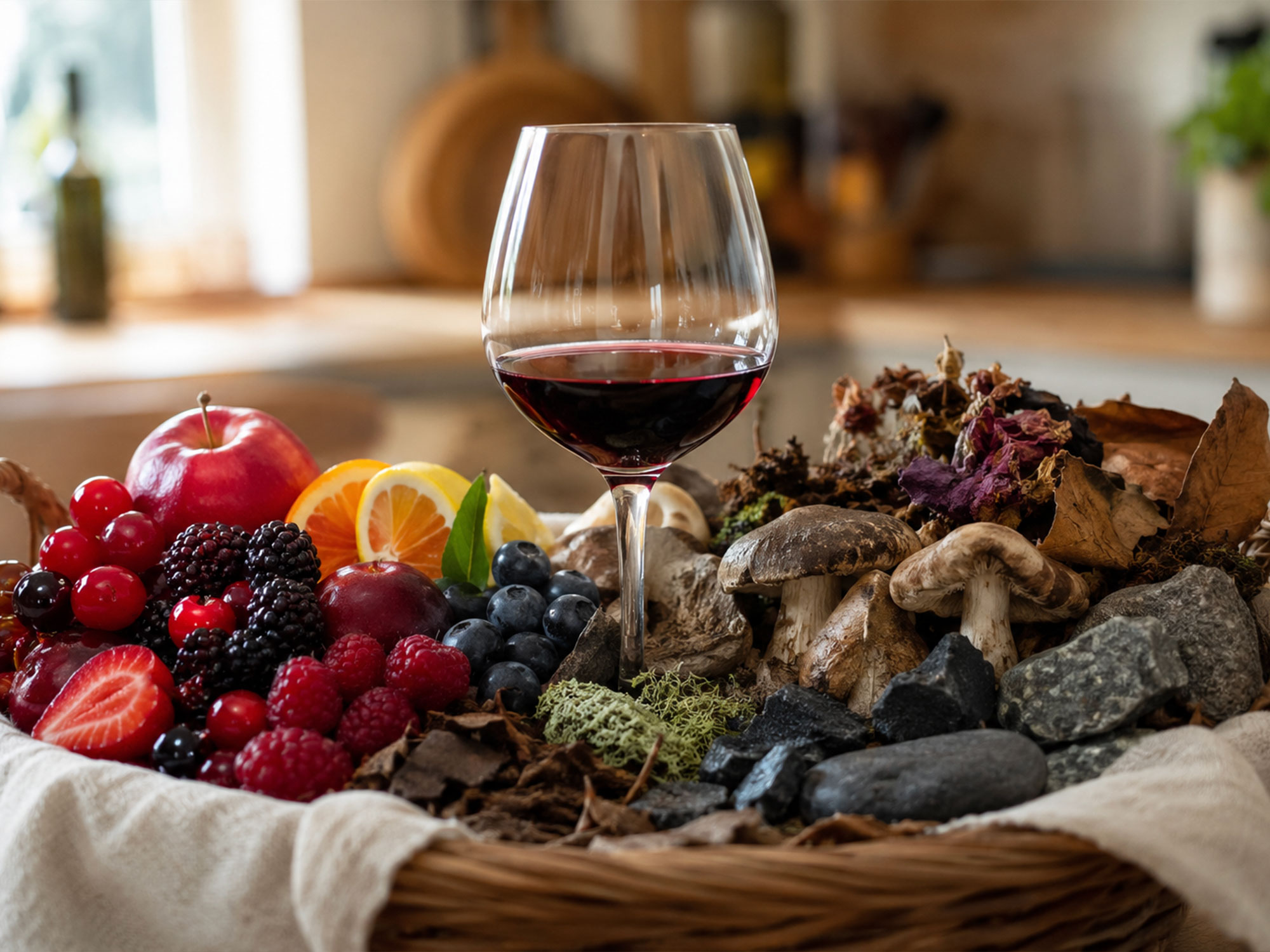
A non-fruit-driven wine is one where the dominant impression, especially on the finish, moves toward earth, mineral, or savory character rather than fruit. Fruit may still be present. It is often still detectable on the nose or the mid-palate. But it is not leading.
This category breaks into two fairly distinct lanes:
The first lane is organic earth. These are notes that feel like something alive or decomposed, in a way that is genuinely pleasant and complex in wine:
These tend to be what people mean when they call a wine “earthy.” They often appear in wines with some age, or in varieties and regions that emphasize site expression over fruit concentration.
The second lane is inorganic earth, or mineral character. These notes feel fresher and more elemental:
Mineral character is distinct from earthy character. Both fall under the non-fruit-driven umbrella, but they feel different in the glass. Earthy notes feel organic and sometimes warm. Mineral notes feel cool, fresh, and precise. Keeping them separate in your structured note-taking will give you more useful information.
This is where a lot of tasting assumptions break down. People assume that certain grapes are always fruity, or that certain regions always produce earthy wines. Neither is reliably true.
Several factors shape where a wine lands on the fruit-to-non-fruit spectrum.
Climate matters. Warmer climates tend to push ripeness, accumulate sugar faster, and produce softer acidity. The result is often louder, more expressive fruit. Cooler climates tend to preserve more restraint, more acidity, and more savory or mineral detail.
Ripeness matters. Even within the same region, a warmer vintage can shift a wine noticeably toward fruit expression. A cooler vintage may pull it back toward more structured, earth-driven character.
Acidity affects perceived fruitiness. Higher acidity can make fruit feel crisper and more restrained. Lower acidity can make fruit feel softer and more forward.
As a general pattern, warmer climates often produce riper, louder fruit. Cooler climates often preserve more restraint and savory detail. This is a useful starting point for pattern recognition in blind tasting, as long as you hold it loosely.
A Shiraz from Barossa Valley and a Syrah from the Northern Rhône are made from the same grape. But the Barossa version tends to show plump, dark, jammy fruit, while the Northern Rhône version often finishes more on earth and savory character, with fruit that is present but less dominant. That comparison does a lot of teaching if you want to try it!
Climate is not the only lever. Winemaking decisions also shape where a wine lands.
Stainless steel fermentation is often used when a winemaker wants to preserve primary fruit and floral aromas. Wines fermented and aged in stainless steel, without oak contact, tend to show cleaner, more direct fruit character. That said, fruit-driven wines can absolutely have oak on them. When there is enough fruit concentration, it can hold up to oak without losing its fruit-forward character.
Carbonic maceration is a technique that can create more juicy, fresh fruit expression in red wines. It is commonly associated with Beaujolais, and it tends to emphasize that bright, immediate fruit character that makes those wines so recognizable.
Age also matters. Younger wines tend to show more primary fruit. As a wine ages, fruit can recede and tertiary notes, including earthy, savory, and sometimes mineral character, can become more prominent.
Oak can appear in both fruit-driven and non-fruit-driven wines. It is not a reliable signal on its own.
There is a general pattern worth knowing: wines from traditional European regions, what we call the Old World, often emphasize site, earth, and restraint. Wines from regions outside Europe, the New World, often emphasize ripeness, fruit expression, and variety character.
This pattern is useful. It gives you a starting point in blind tasting, and it reflects something real about how wines from these regions have historically been made and styled.
But it is a shorthand, not a rule. There are fruit-forward European wines. There are restrained, mineral-driven wines from California, New Zealand, and South Africa. The gray area is growing, and the best tasters hold this framework loosely while still using it as a working hypothesis.
Use Old World vs. New World as one clue among several, not as a conclusion.
The fruit vs. non-fruit distinction is not a final answer. It is a decision point that helps you narrow your thinking.
Here is how to work it into your tasting practice:
Ask where the wine finishes. A wine might show some fruit early and then move toward earth or mineral on the finish. The finish is where you make the call.
Build a consistent note-taking habit. In your tasting framework, give yourself dedicated space for fruit character, mineral character, and earth driven tertiary notes. See if one area dominates consistently.
Use the observation as one clue, not the whole answer. A wine that finishes on mineral and earth is not automatically a European wine. A wine that finishes on ripe fruit is not automatically from a warm New World region. But combined with other structural observations, the fruit vs. non-fruit distinction helps you build a more informed conclusion.
The fastest way to calibrate this distinction is to taste two wines side by side. Comparative tasting forces you to make a relative judgment rather than an absolute one, and relative judgments are more reliable.
Comparative Tasting Examples
| Pairing | What to Compare | What to Listen For |
|---|---|---|
| New Zealand Sauvignon Blanc vs. Sancerre | Fruit intensity and finish character | One will finish more on ripe tropical and citrus fruit; the other will lean toward mineral and earthy restraint |
| Napa Cabernet Sauvignon vs. Bordeaux | Fruit concentration and earth presence | One will show bolder, riper fruit and oak; while the other tends to be more restrained, with more earth and structure on the finish |
| Barossa Shiraz vs. Northern Rhône Syrah | Ripeness level and finish direction | One will show plump, dark, jammy fruit; the other tends to finish more on savory and earthy notes |
In each pair, ask one question after tasting: which one finishes more on fruit? Write a single line for each wine. Keep the language simple and consistent. Repeat the comparison across multiple sessions and track whether your conclusions stay consistent over time!

Use this at the end of any tasting note to capture the fruit vs. non-fruit distinction:
Table: Fruit-Driven vs. Non-Fruit-Driven Wine
| Tasting Cue | Fruit-Driven Example | Non-Fruit-Driven Example | What It Suggests |
|---|---|---|---|
| Aroma intensity | Ripe tropical or dark fruit, loud and immediate | Restrained fruit, earth, or mineral on the nose | Fruit-driven wines often announce themselves early |
| Fruit type | Tropical, stone fruit, ripe berry, jammy | Tart apple, lemon, or fruit that fades quickly | Riper fruit reads as more expressive |
| Finish | Returns to fruit character | Moves toward earth, mineral, or savory | The finish is the most reliable indicator |
| Earthy notes | Minimal or secondary | Forest floor, mushroom, wet leaves, dried flowers | Organic earth suggests a non-fruit-driven style |
| Mineral notes | Minimal or secondary | Wet stone, slate, graphite, smoke | Inorganic mineral suggests a different kind of non-fruit character |
| Climate clue | Often warmer climate | Often cooler climate or European region | Useful pattern, not a rule |
| Possible wine styles | Marlborough Sauvignon Blanc, Barossa Shiraz, Napa Cabernet | Sancerre, Northern Rhône Syrah, Bordeaux | Compare these pairs to build calibration |
If this is starting to click for you, the next step is really just practice, but with structure.
If you want a simple place to actually apply this in real time, I built my Blind Tasting Framework as a note-taking system you can use while you taste.
It’s designed to take ideas like this and turn them into something repeatable, so your notes start feeling less like guesswork and more like pattern recognition over time.
The fruit vs. non-fruit distinction is one piece of a larger system. But it is a genuinely useful piece, and the sooner you start tracking it consistently, the faster your tasting confidence builds.
Explore Oregon’s 23 AVAs, from the renowned Willamette Valley to emerging regions like Rogue and Applegate, where cool-climate wines thrive.
Explore Tokaji’s diverse wine styles, from the intensely sweet Eszencia and Aszú to the refreshing dry Furmint, each showcasing unique flavors and aging potential.
Embark on a journey through Rioja’s 3 subregions: Alta, Alavesa, and Baja. Each offers unique terroirs & winemaking traditions that shape Spain’s iconic Tempranillo wines.
(Learn to Taste or Refresh Foundations)
(Ask, Discuss, & Connect)
(Gain Tasting Confidence)
Join our totally free community, which includes:
Just submit your info to receive your invite!
By submitting, you are consenting to receive marketing emails from The Grape Grind, including much of the core educational content you’re specifically signing up for now. You can unsubscribe at any time.
Joining the free Grape Grind community means your wine tasting journey begins NOW!
STEP 1 of 2 – Fill this out:
After you click the button above, you’ll be asked to enter your email again to set up your free account. Please use this same email address to create your account.
By submitting, you are consenting to receive marketing emails from The Grape Grind, including much of the core educational content you’re specifically signing up for now. You can unsubscribe at any time.
Learn & improve your wine tasting skills for free!