A Quick Guide to Stainless Steel in Winemaking
Discover how stainless steel tanks preserve purity, precision, and crisp vibrancy in modern wine.
Make 2026 THE year.
Take 10% OFF your first 12 months of Tasting Group!
Code:
This is not a beginner mistake. Attentive tasters can find themselves hesitating between both Chardonnay and Chenin Blanc, especially when the wine in the glass is relatively neutral, shows some oak, and sits comfortably in orchard fruit territory.
Here is why the overlap happens.
Both varieties can be neutral. Chardonnay is often described as a blank canvas, and that reputation is earned. But Chenin Blanc is also capable of sitting in a restrained, low-aromatic lane, especially in certain styles and climates. It is a chameleon grape, and that flexibility is exactly what makes it easy to misread.
Both can show orchard fruit and citrus. Apple, pear, lemon, a little lime. Neither variety announces itself with a dramatic signature aroma the way some grapes do.
Both can be oaked. Chardonnay is commonly associated with oak aging, but Chenin Blanc can see oak too, depending on where it is grown and how the winemaker approaches it.
Both can have lees influence. That added texture and weight that you might associate with a richer Chardonnay can appear in Chenin Blanc as well.
Both can show high acid in cool climates. So if you are tasting something that feels crisp and structured, acid alone will not make the call for you.
The point is not that these two varieties are the same. They are not. But the overlap is real enough that Chenin Blanc deserves a place in your comparison set any time you are considering a neutral, possibly oaked, orchard-fruited white wine. If your brain goes to Chardonnay, that is a reasonable first instinct. It just should not be the last thought.
Acid is one of the most useful places to begin, because it starts narrowing the field.
Chenin Blanc tends to hold onto its acidity. Even in warmer climates, it often retains a persistent, mouthwatering quality that keeps the finish lively. The acid does not disappear. It keeps going.
Chardonnay is generally considered a medium-acid variety. Cool climate examples can be quite sharp and may close the gap with Chenin considerably, but as Chardonnay moves into warmer growing conditions, it tends to soften. The acidity becomes more integrated, less driven.
So when you are assessing acid, the question is not just “is this wine high or low acid?” It is closer to: does the acid feel persistent and mouthwatering, or does it feel more settled and integrated into the wine? That distinction is not always easy to call, but go ahead and ask it every time!
Climate matters here. A cool climate Chenin Blanc and a cool climate Chardonnay can feel closer together in terms of acidity than you might expect. The gap widens when you move into warmer regions, where Chardonnay tends to lose its edge faster than Chenin does.
If acid is where you start, texture is often where your decision gets made.
Chenin Blanc has a natural textural quality that is somewhat unusual. It can feel waxy, lanolin-like, beeswax-like, slightly oily. The sensation isn’t dramatic,, but it is distinct once you know what you are looking for. The texture tends to coat the palate in a particular way.
Chardonnay can feel creamy or rounded, especially with oak and lees influence. But creamy is different from waxy. Chardonnay’s texture tends to come from winemaking. Chenin’s texture tends to come from the grape itself.
Taste them side by side to see how this shows up for you. This distinction is important because it gives you something to anchor to even when the winemaking is doing a lot of work. Oak and lees can add texture to both varieties, which can blur the picture. But if you strip away what the winemaking might be contributing and ask what the grape itself feels like, Chenin tends to leave a slightly different impression on the palate.
The practical question to ask yourself: does this feel creamy, or does it feel waxy? Does it feel rounded, or does it feel like it leaves a slight coating?
Both varieties sit in orchard fruit territory. That is where the comparison starts, and it is also where a lot of tasters get stuck.
Chardonnay tends to read fresher and cleaner in its fruit profile. Apple and pear that feel crisp, sometimes a little green in cooler climates, sometimes more tropical in warmer ones, but generally straightforward.
Chenin Blanc can feel a little different. There can be a slightly more funky, bruised, or dried-fruit quality to it. Sometimes a hint of beeswax or candle wax in the aroma. Sometimes something closer to quince or dried apple rather than fresh apple. It is not always obvious, but it is a different kind of fruit expression than Chardonnay’s fresher profile.
Chenin can also sometimes feel slightly more aromatic overall. Not intensely so, but where Chardonnay is quiet, Chenin may offer just a little more complexity or a slightly more unusual character.
None of this is a guarantee. Climate and winemaking can push both varieties in many directions. But if you notice that the fruit feels a little more interesting, a little more textured or funky, that is worth filing away as a potential Chenin signal.
Chardonnay is the variety most commonly associated with oak aging in the minds of many wine students. That associationis a good one, but it does create a mental shortcut that can cause problems. If you assume the oaked white wine in the glass is Chardonnay, you may stop looking at everything else.
Chenin Blanc can also be oaked. It can also see significant lees aging. In certain styles, particularly from regions like the Loire Valley or parts of South Africa, you might encounter a Chenin Blanc that feels full, textured, and has clear oak influence. If you are not expecting that, it can read as Chardonnay.
The key point here is that oak can mask grape identity. When a wine has significant winemaking influence, you have to work harder to find the grape underneath. That means leaning more heavily on texture, acid behavior, and fruit character, the things that are harder to disguise, rather than relying on oak as a variety identifier.
Style matters as much as variety. A lightly oaked Chardonnay and a lightly oaked Chenin Blanc may be easier to separate than two heavily oaked examples of the same varieties. Keep that in mind when you are calibrating your expectations.
The comparison between these two varieties does not stay the same across climates.
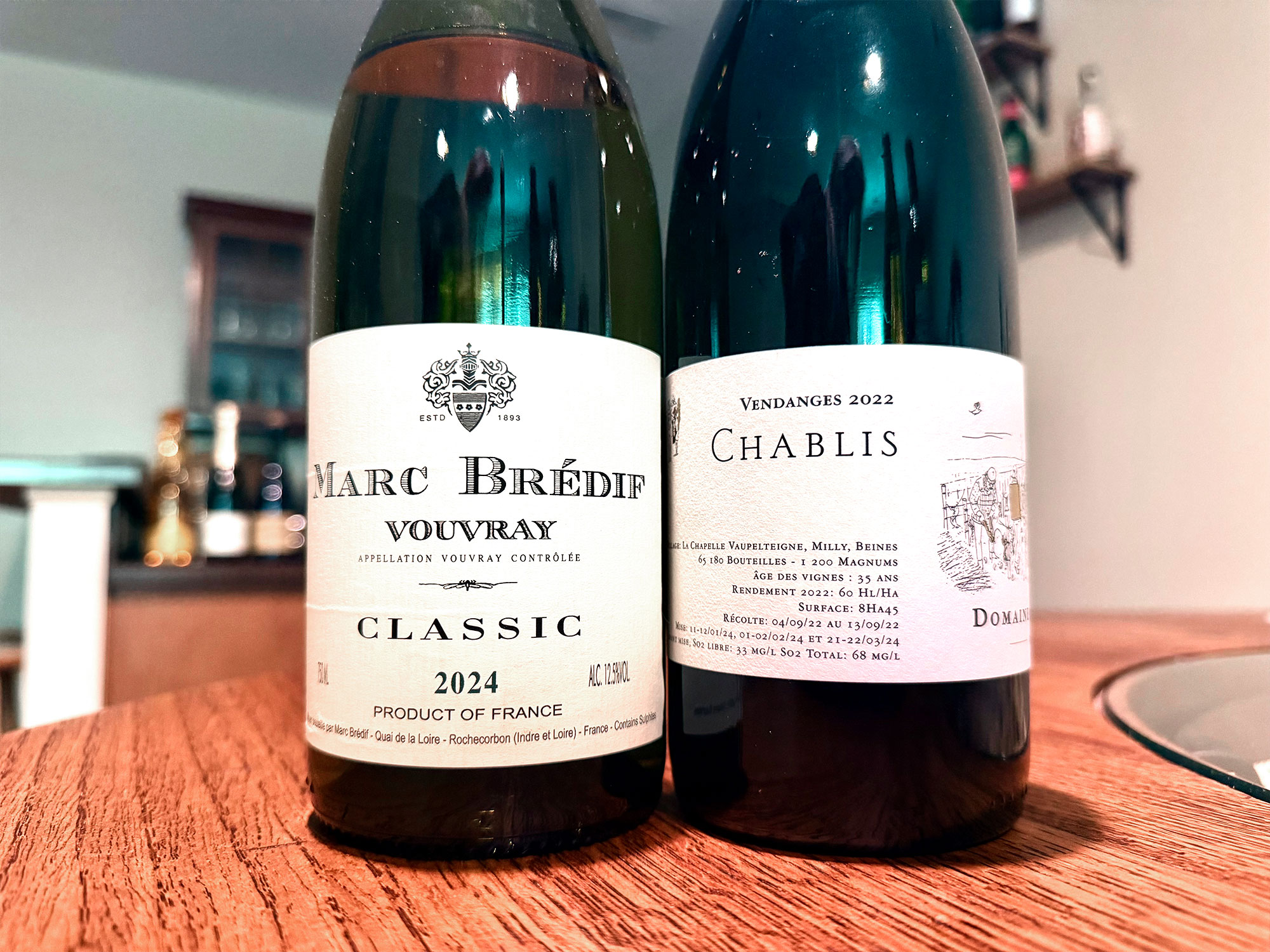
In cool climates, both varieties can feel relatively neutral, high in acid, and restrained in fruit. A cool climate Vouvray and a cool climate Chardonnay from somewhere like Chablis can taste quite similar on their own. Side by side, differences tend to emerge more clearly. Chenin’s acid may feel slightly more persistent, and there may be a subtle waxy quality that Chardonnay does not share. But tasted in isolation, they can be genuinely close.
In warmer climates, the comparison shifts. Warm climate Chardonnay tends to soften in acid and move toward riper, sometimes more tropical fruit. Warm climate Chenin Blanc, such as examples from South Africa, can also show riper fruit, but it tends to hold onto more acid and retain that textural quality. The two wines may both feel generous and fruit-forward, but Chenin typically still has more persistence.
Knowing the likely climate of the wine in the glass helps you adjust your expectations before you start assessing. It is part of building a repeatable tasting process rather than trying to apply one fixed rule to every situation.
This is the part that matters most for structured blind tasting practice. Rather than chasing a single aroma or hoping for an obvious tell, the goal is to move through a consistent set of questions and let the combination of answers guide your conclusion.
Here is a simple sequence that works for this comparison.
Step 1: Assess acid. Does the acid feel persistent and mouthwatering, or more integrated and settled? Persistent acid is a signal worth noting.
Step 2: Assess texture. Does the wine feel creamy and rounded, or is there something waxy or slightly oily about it? Waxy texture is a Chenin signal.
Step 3: Assess fruit character. Is the fruit fresh and clean, or is there something slightly more funky, bruised, or dried-fruit-adjacent? A slightly unusual fruit quality may point toward Chenin.
Step 4: Assess oak and lees influence. Is there oak present? How significant is it? Is it masking the grape, or can you still read the underlying character?
Step 5: Ask the overall question. Based on everything you have assessed, does this wine feel more Chardonnay-like or more Chenin-like? You may not be certain. That is fine. Make a call based on the weight of evidence, not on any single clue.
This is how reducing guesswork in blind tasting actually works. Not by finding the one magic aroma, but by building a consistent process and letting multiple signals point in the same direction.
| Category | Chardonnay | Chenin Blanc | What to Listen For |
|---|---|---|---|
| Acid | Medium; softer in warm climates, sharper in cool | Often persistent and mouthwatering; holds acid even in warm climates | Does the acid keep going or settle? |
| Texture | Creamy, rounded; texture often from oak or lees | Waxy, lanolin-like, beeswax-like; texture often from the grape itself | Creamy vs. waxy coating on the palate |
| Fruit | Fresh, clean; apple, pear, sometimes tropical in warm climates | Orchard fruit with possible funky, bruised, or dried-fruit quality; quince, beeswax | Fresh and clean vs. slightly unusual or textured |
| Oak | Commonly associated with oak aging | Can also be oaked, especially in Loire and South Africa | Oak can mask both; look past it |
| Lees | Common; adds creaminess and weight | Also used; adds weight and texture | Both can feel fuller; look for what is underneath |
| Climate | Acid softens noticeably in warm climates | Acid more persistent across climates | Warm climate acid behavior is a useful separator |
| Overall impression | Neutral, clean, often creamy or fresh | Neutral, but with more textural complexity and occasionally funky character | Chenin tends to feel more unusual on the palate |
Reading about these differences is a starting point. The real calibration happens when you taste both wines together.
Side-by-side comparative tasting accelerates pattern recognition in a way that tasting one wine at a time simply cannot. When the contrast is in the glass, your palate has something to measure against!
Here are a few practice setups worth trying.
Cool climate dry Vouvray vs. cool climate Chablis. This is probably the most instructive pairing. Both wines will feel restrained and relatively neutral. The differences in acid persistence and texture will be subtle, but they will be there.
South African Chenin Blanc vs. South African Chardonnay. Warmer climate, riper fruit, similar growing conditions. This pairing tests whether you can separate the varieties when the climate is working against you. Look for acid behavior and texture as your primary anchors.
California Chenin Blanc vs. California Chardonnay. California Chardonnay can range widely in style. Finding a California Chenin Blanc takes a little more effort, but the comparison is useful for the same reasons as the South African pairing.
| Scenario | Why It Helps | What to Notice |
|---|---|---|
| Cool climate Vouvray vs. cool climate Chardonnay (e.g., Chablis) | Tests your ability to find subtle differences when both wines are restrained and neutral | Acid persistence, waxy texture in Chenin, fruit character |
South African Chenin Blanc vs. South African Chardonnay (Stellenbosch) | Tests separation in a warmer climate where both wines can feel riper and more generous | Acid retention in Chenin, textural difference, fruit ripeness |
| California Chenin Blanc vs. California Chardonnay | Broader style range; tests whether your framework holds across different winemaking approaches | Oak influence, fruit expression, overall palate feel |
When you taste these side by side, take notes using a simple framework: acid, texture, fruit, oak, finish. Write down what you observe before you look at the labels. Then compare. Over time, the patterns will become easier to recognize on their own.
Uncertainty is a normal part of blind tasting, and it is worth treating it that way rather than as a failure.
No single clue is enough to make a reliable call between these two varieties. Not the acid alone. Not the texture alone. Not the presence of oak. What builds consistency in blind tasting is the habit of looking at all of those things together and weighing the combination.
If you are not sure, ask yourself which direction the evidence is pointing. More signals pointing toward waxy texture, persistent acid, and slightly unusual fruit? That is a Chenin case. More signals pointing toward clean fruit, integrated acid, and creamy texture? That is a Chardonnay case. Make the call, then find out if you were right.
The comparison itself is the practice. Every time you taste these two wines with structure and write down what you observe, you are building a more reliable internal reference. That is what calibration actually looks like. Not certainty, but a progressively more accurate sense of where each variety tends to sit.
Keep practicing with a framework. Keep comparing across climates and styles. The pattern recognition you are building now is the same skill that holds up under pressure.
If you want to take this kind of structured comparative work further, come taste with us in the Tasting Circle. Each month, we put two wines side by side and work through the kind of clues you just practiced—so you can build your palate, sharpen your pattern recognition, and get better at making those calls with confidence.
Not ready to join yet? Start with our free community The Tasting Room. You’ll still get side-by-side tasting inspiration, wine education, and ideas for what to taste on your own. You don’t have to know everything to start building your palate, you just need a couple of wines and a willingness to taste!
Discover how stainless steel tanks preserve purity, precision, and crisp vibrancy in modern wine.
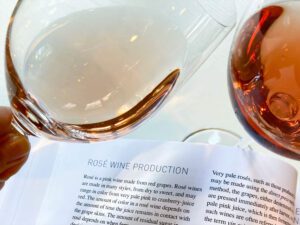
Learn the three primary methods of rosé production (direct press, saignée, and blending) and how each influences color, flavor, and style.
Learn which wines can age beautifully, how they evolve, and what to watch for in that journey of transformation.
(Learn to Taste or Refresh Foundations)
(Ask, Discuss, & Connect)
(Gain Tasting Confidence)
Join our totally free community, which includes:
Just submit your info to receive your invite!
By submitting, you are consenting to receive marketing emails from The Grape Grind, including much of the core educational content you’re specifically signing up for now. You can unsubscribe at any time.
Joining the free Grape Grind community means your wine tasting journey begins NOW!
STEP 1 of 2 – Fill this out:
After you click the button above, you’ll be asked to enter your email again to set up your free account. Please use this same email address to create your account.
By submitting, you are consenting to receive marketing emails from The Grape Grind, including much of the core educational content you’re specifically signing up for now. You can unsubscribe at any time.
Learn & improve your wine tasting skills for free!